
Is Your Workplace Too Hot? How Air Conditioning Can Help Canterbury Businesses
JIB Cooling

Heat in the workplace used to be an occasional inconvenience in the UK. Open a window, bring in a fan and wait for the inevitable change in the weather.
The summer of 2026 has been quite different to what us Brits expect and has businesses thinking about how to handle extreme heat.
What do we mean by extreme heat?
The UK recorded a temperature of 35.1°C at Kew Gardens on 26 May 2026, setting a new UK May temperature record. By late June, temperatures had climbed even higher, with the Met Office reporting a provisional UK June record of 37.7°C at Lingwood in Norfolk.
This isn't simply about people feeling a little warm.
During the June heatwave, hundreds of schools across southern England and Wales closed or finished early because of the extreme temperatures. Headteachers reported using fans and portable air conditioning where possible, with some schools struggling to keep older buildings comfortable.
Businesses were affected too. Shops, cafés, restaurants and salons were among those reported to have temporarily closed or reduced their opening hours because conditions had become uncomfortably hot for staff.
For businesses in Canterbury, the question is becoming increasingly relevant:
Is your workplace equipped to cope when temperatures climb into the mid-30s?
How Hot Is Too Hot for a Workplace?
There isn't a single temperature at which every workplace suddenly becomes unsuitable.
A quiet office, busy restaurant kitchen, retail unit and warehouse are very different working environments. Humidity, airflow, direct sunlight, physical activity, clothing and equipment can all influence how comfortable a space feels.
Importantly, there is no specific maximum legal workplace temperature in the UK.
The government states that temperatures inside workplaces must be "reasonable", while employers must comply with their wider health and safety responsibilities. The Health and Safety Executive also advises employers to manage the risks associated with uncomfortable workplace temperatures.
That distinction matters. The absence of a legal number such as 30°C does not mean businesses can simply ignore excessive heat.
The HSE recommends considering practical measures to maintain thermal comfort, including local cooling where comfortable temperatures cannot otherwise be maintained.
For a Canterbury business experiencing increasingly hot summers, that may mean looking beyond office fans and considering commercial air conditioning as a more permanent solution.
Why Do Some Workplaces Become So Hot?
Outdoor temperature is only part of the problem. A building can become considerably more uncomfortable because it continues accumulating heat throughout the day.
A south-facing office with large windows, for example, can receive substantial solar gain. Computers, lighting, refrigerators, cooking equipment and other machinery can add further heat.
Then add employees and customers.

A meeting room that feels comfortable with two people inside may feel very different when ten people are using it on a hot afternoon.
Some modern buildings can also retain heat extremely effectively. Insulation is invaluable during winter, but once a building becomes hot during a prolonged summer spell, that heat can sometimes be difficult to remove.
Older buildings bring different challenges. Canterbury has a wide variety of commercial property, from modern offices and retail units to older converted buildings where ventilation and cooling may never have been part of the original design.
The result can be a workplace where opening windows and placing a couple of desk fans around the room simply isn't enough.
Can a Hot Workplace Affect Productivity?
Most of us recognise the feeling. You're sitting at a desk trying to concentrate, but the room is hot and stuffy. Instead of focusing on the work in front of you, you're thinking about the temperature.
People may feel tired, uncomfortable or distracted. That matters in an office, but it can be equally relevant in almost any workplace.
A salon employee may be using electrical equipment that generates additional heat. A chef or hospitality worker may already be working in a naturally warm environment. Retail employees can spend hours serving customers in a shop with large glazed windows.
Extreme temperatures can turn workplace cooling from an employee perk into a practical operational issue.
It is also worth thinking about what happened during the 2026 heatwaves. This summer provided real examples of organisations being unable to continue operating normally because their buildings could not cope comfortably with the conditions.
Schools shortened days or closed. A number of businesses also chose to shut or reduce hours, including eateries, shops and salons.
For a business, even a few lost afternoons can mean cancelled appointments, reduced sales, disrupted production or employees unable to work normally.
Commercial air conditioning therefore isn't only about making a building feel pleasant. Increasingly, it can form part of a business's approach to keeping its workplace usable during periods of extreme summer weather.
The UK Climate Is Changing
It is tempting to dismiss extreme heat as an unusual event that probably won't happen again for years. The longer-term data suggests businesses should be cautious about making that assumption.
According to the Met Office's State of the UK Climate information, 2025 was the warmest year in the UK temperature series dating back to 1884, while the four most recent years all sit within the five warmest.
The decade from 2016 to 2025 was 0.51°C warmer than the 1991 to 2020 average and 1.33°C warmer than 1961 to 1990.
The Met Office also reports that the UK has warmed by approximately 0.25°C per decade since the 1980s.
And then came 2026. Spring 2026 was the warmest spring on record for England and Wales, helped by the exceptional heat experienced at the end of May. During the late June heatwave, a provisional UK June temperature record of 37.7°C was recorded.
(series began 1884)
record, late June 2026
since the 1980s
Decade average (2016 to 2025) vs earlier baselines
The 2016 to 2025 decade was 0.51°C warmer than the 1991 to 2020 average, and 1.33°C warmer than the 1961 to 1990 average.
Source: Met Office, State of the UK Climate
For businesses planning premises that they expect to occupy for five, ten or twenty years, these trends are difficult to ignore. The commercial buildings we use may need to operate successfully in a different climate from the one they were originally designed for.
Which Canterbury Businesses Could Benefit From Air Conditioning?
Commercial air conditioning isn't just something for large corporate offices. It can be suitable for many different types of premises in and around Canterbury.
Converted offices are an obvious example, particularly rooms with multiple computers, large windows or poor natural airflow.
Retail environments can benefit because temperature affects employees as well as the customers spending time inside the shop.
Restaurants, cafés and hospitality businesses often face additional heat from kitchens, coffee machines, refrigeration equipment and numbers of customers.
Salons and beauty businesses frequently use hairdryers, lighting and electrical equipment throughout the working day.
Clinics, dental practices and treatment rooms may require a more consistently comfortable environment for both staff and patients.
Gyms and studios present another challenge because occupants are physically active and therefore particularly sensitive to an uncomfortable environment.
The important point is that there isn't a single commercial air conditioning solution suitable for every building.
What Type of Air Conditioning Does a Commercial Property Need?
Choosing commercial air conditioning involves more than measuring the room and picking a unit from a catalogue. A professional installer needs to understand how the building is actually used.
The assessment may consider room dimensions, ceiling height, insulation, glazing, orientation, occupancy and the amount of heat produced by equipment.
There may also be several areas of the building that need independent temperature control.
This is why a professional site survey is such an important part of planning commercial air conditioning in Canterbury.
How Do I Know What Size Air Conditioner My Office Needs?
The correct air conditioning capacity depends on more than floor area.
An experienced installer will normally consider the size and shape of the room, glazing, insulation, sunlight, the number of occupants, heat generated by equipment and how the space is used.
Installing a system that is properly matched to the building helps it operate effectively without unnecessarily over-specifying the equipment.
Air Conditioning Isn't Necessarily Just for Summer
Another reason commercial air conditioning is becoming attractive to businesses is that many modern systems are capable of both cooling and heating.
Rather than thinking of air conditioning as equipment that only gets switched on during a heatwave, suitable systems can help provide comfortable temperatures throughout more of the year.
Rather than equipment switched on only during a heatwave, a reversible system provides cooling in summer and heating in colder periods, giving comfortable temperatures throughout more of the year.
During summer, the system provides cooling. During colder periods, many systems can reverse the process and provide heating.
For some commercial environments, that flexibility can make air conditioning part of the wider heating and cooling strategy for the premises rather than simply an emergency response to hot weather.
What About Customers?
When discussing workplace temperature, attention naturally focuses on employees. Customer comfort deserves consideration too.
Imagine walking into two cafés on an exceptionally hot day. One is noticeably cooler and comfortable. The other is hot and stuffy.
Where would you prefer to sit?
The same question can apply to shops, salons, restaurants, gyms, waiting areas and other customer-facing environments.
You may not be able to quantify exactly how many customers leave because they are uncomfortable, but creating a pleasant environment is an obvious part of delivering a good customer experience.
That becomes particularly relevant when outdoor temperatures reach the levels seen during 2026.
Why Plan Commercial Air Conditioning Before the Next Heatwave?
The worst possible time to start thinking seriously about overheating is when employees are already sitting in an unbearably hot office. At that point, the problem has become urgent.
Planning ahead allows a business to look at the building properly.
- Where should indoor units be positioned?
- Where can outdoor equipment go?
- How will pipework be routed?
- Which areas actually require cooling?
- Could several areas benefit from individual temperature control?
- Will installation need to be scheduled around customers or employees?
These decisions are easier to make when the objective is to design the right solution rather than simply find the fastest possible response to a heatwave.
It also enables installation work to be planned around the business. For a customer-facing company, that may mean arranging work outside busy trading periods. For an office, it might mean coordinating installation with refurbishment or other building work.
If you're planning an office, shop or commercial fit-out in Canterbury, considering air conditioning early can also make installation much easier to integrate into the finished property.
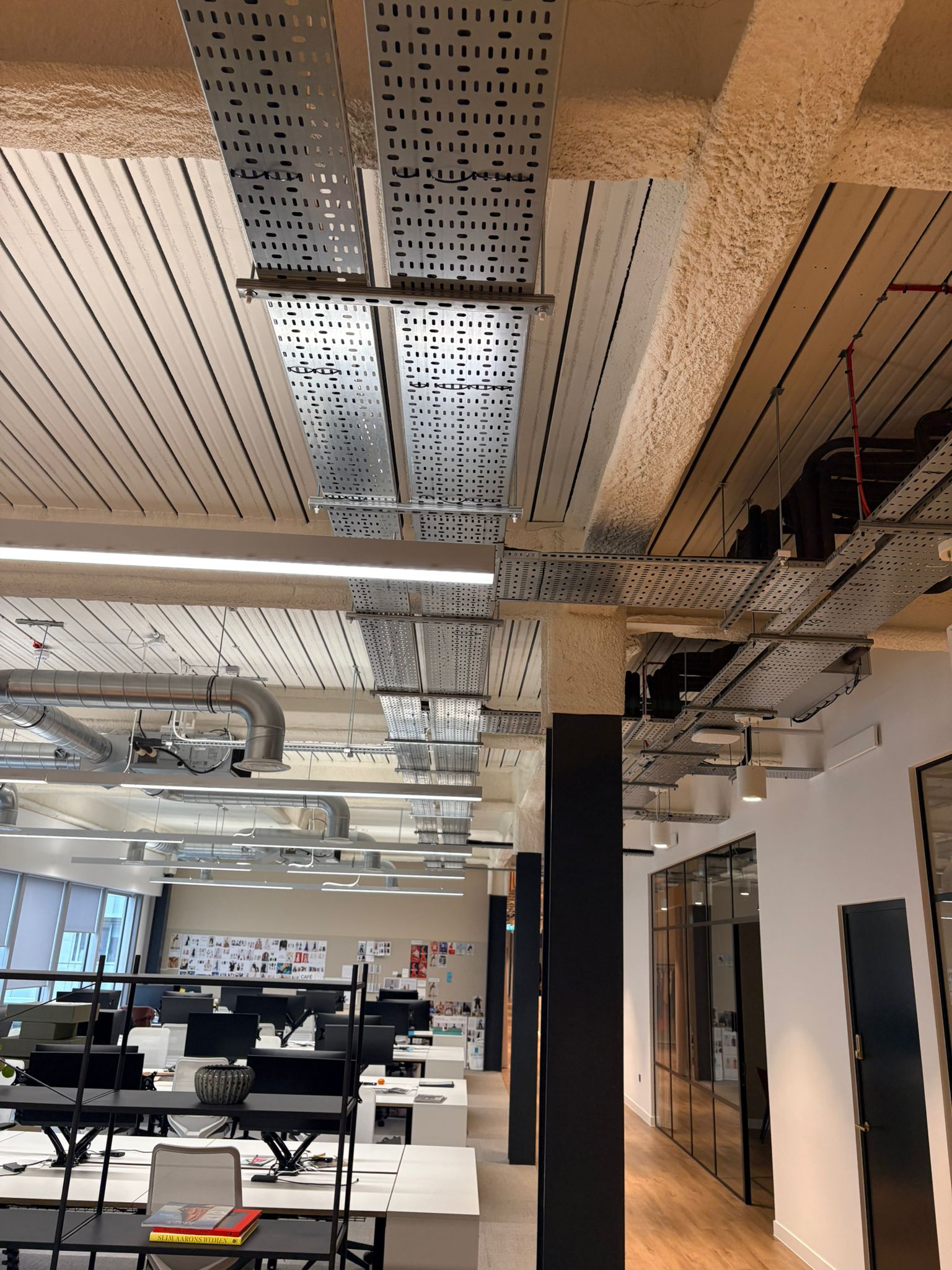
Commercial Air Conditioning Installation in Canterbury
The temperatures experienced during 2026 have made one thing increasingly difficult to argue: extreme summer heat in the UK can simply be treated as somebody else's problem.
Schools have closed or shortened their days. Businesses have temporarily closed or reduced trading hours. Temperature records have been broken. And longer-term Met Office data shows that the UK climate is getting warmer.
For Canterbury businesses, that makes it sensible to consider whether premises are properly equipped for the summers ahead.
JIB Cooling provides commercial air conditioning installation for offices, shops and other businesses in Canterbury and across East Kent.
Every installation starts with understanding the building, how it is used and what the business actually needs. From individual rooms through to larger commercial environments, the aim is to specify an air conditioning system appropriate for the space rather than taking a one-size-fits-all approach.
If your workplace regularly becomes uncomfortable during hot weather, or you're planning a new commercial space, refurbishment or fit-out, now may be the right time to consider your options.
Looking for air conditioning installers in Canterbury? Speak to JIB Cooling about your premises and arrange a professional air conditioning survey before the next heatwave arrives.